

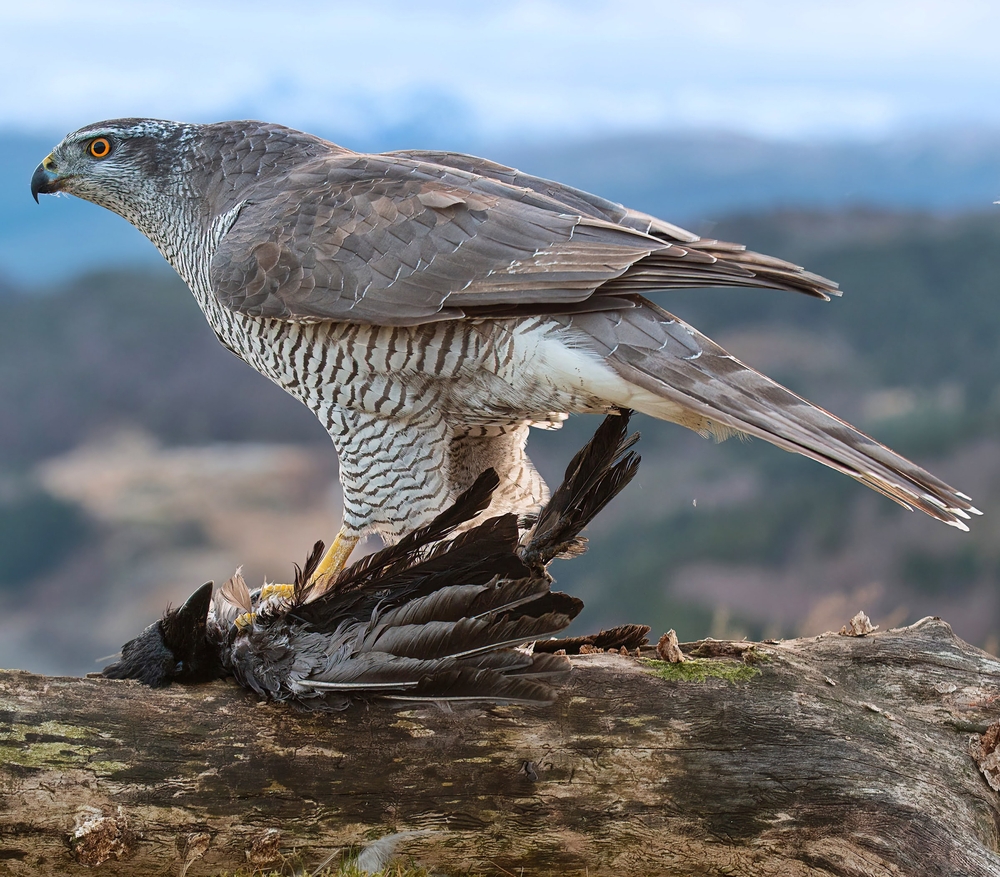
Foraging strategies of the Eurasian Goshawk
Goshawks of the Ancient Forest: Why “Optimal” Foraging Isn't One-Size-Fits-All
The Eurasian Goshawk has long been treated as a symbol of untouched, old-growth woodland — a species that supposedly thrives only where forests remain wild and structurally complex. A new study from the Białowieża Forest, the largest surviving lowland primeval forest in Europe, complicates that picture in a striking way.
Researchers Ülo Väli and Paweł Mirski fitted 13 male Goshawks with GPS-GSM trackers during the 2024 and 2025 breeding seasons, logging a location every ten minutes as the birds hunted to feed their mates and chicks. They also collected prey remains from nests to reconstruct each bird's diet, and monitored how many chicks each pair successfully raised.
Rather than converging on one "best" way to hunt, the tracked males split into three distinct behavioral types:
- Forest specialists (5 birds) stayed almost entirely within the old-growth forest, hunting a classic woodland menu of Wood Pigeons, woodpeckers, and Hazel Grouse. Their hunting grounds were compact — under 17 km² on average.
- Forest–farmland generalists (3 birds) supplemented forest hunting with trips into nearby fields and villages, picking up species like Tawny Owls, crows, and thrushes. This came with the broadest diet and the largest, most sprawling ranges.
- Forest–town commuters (5 birds) hunted mainly around the nest but also made regular — often near-daily — journeys of up to 20 km into the town of Hajnówka to catch feral pigeons. Remarkably, some of these birds nested deep in the forest interior, far from any obvious "urban" cue, yet still made the long commute.
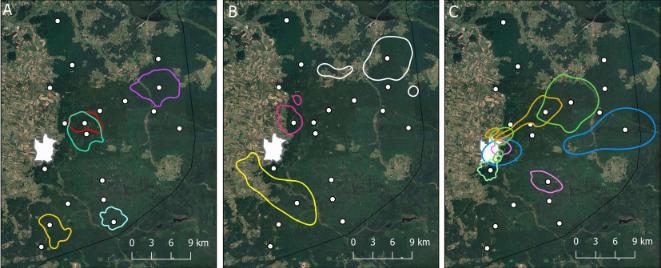
farmland (B), and in forest and town (C). Foraging areas of individual birds are indicated by different colours.
The town of Hajnówka is shown as a white polygon. White dots indicate known active Goshawk nests
What's surprising is what didn't predict these strategies. The team tested whether home-range size related to forest quality, stand age, canopy structure, or distance to farmland and settlements around each nest — and found no significant relationships. Forest cover exceeded 70% at every nest site studied, yet neighboring males living in nearly identical surroundings adopted completely different hunting styles. One bird would forage exclusively in ancient forest, while its neighbor a few kilometers away made regular runs to town for pigeons.
The pigeon-hunting strategy also seemed to pay off best. Town-foraging males had the narrowest diet (dominated by feral pigeons) and the highest average brood size — 2.4 chicks per nest — compared to 2.0 for forest specialists and just 1.0 for the farmland group, though the differences weren't statistically significant given the small sample. The pattern echoes a broader idea in optimal foraging theory: a narrow diet built around one abundant, reliable, easy-to-catch prey species often signals — and drives — greater breeding success.
Why would a goshawk nesting in pristine forest bother flying 20 km each way for pigeons? The authors suggest the explanation may lie in the birds' own life histories rather than their nest surroundings. Goshawks are known to congregate in towns during the non-breeding season and as immatures. A male that grew accustomed to abundant urban prey before settling down may retain that preference even after establishing a breeding territory deep in the forest — commuting back to the food source it already knows works.
The broader message: even in one of Europe's last true wildernesses, a supposedly "forest-dependent" apex predator is quietly exploiting the human-altered landscape next door. Rather than a single optimal foraging strategy, several strategies appear equally viable — a reminder of just how behaviorally flexible Goshawks are, and a hint at how such adaptability might help wildlife persist as landscapes become ever more human-shaped.
Source:
In order to leave a comment, you need to log in!