

Birds of Prey on Solar Farms: An Unexpected Alliance of Energy and Ecology
Birds of Prey on Solar Farms: An Unexpected Alliance of Energy and Ecology
In March 2026, the prestigious scientific journal Journal of Environmental Management published an article by Polish researchers Paweł Czechowski, Olaf Ciebiera, and Piotr Zduniak, which overturns conventional understanding of the impact of solar energy on nature.
The scientists were interested in a question that had remained largely unexplored: how large-scale photovoltaic farms affect birds of prey — key predators at the top of food chains and sensitive to any changes in ecosystems. Previous studies focused either on small installations or small bird species and were limited to the nesting season. The Polish team decided to go further and conducted a year-round study on an impressive 177-hectare site located in the western part of the country near the town of Sulechów.
The experiment was simple and elegant: the researchers divided the area into four equal-sized plots, each 59 hectares. The first plot was occupied by a large 25-megawatt photovoltaic farm — a classic field lined with rows of solar panels. The other three plots served as comparison sites: traditional arable fields, perennial meadows, and roadsides. Over the course of a year, the scientists conducted 36 field visits, recording every encounter with a bird of prey.
The results exceeded expectations. Over the year of observations, nearly a thousand encounters with raptors representing eight different species were recorded, accounting for exactly one-third of the total diversity of raptors in the region. The most frequent visitors were the common buzzard and kestrel, together accounting for over 80% of all encounters. And where one might expect depleted fauna, on the solar farm grounds, the ornithologists found the opposite.
Photovoltaic installations consistently outperformed all other habitat types in three key areas: they had the highest number of raptor sightings, higher species diversity, and simply hosted a greater variety of species. The greatest differences were observed during the birds' most important periods — the peak nesting season, the dispersal of young, and the autumn migration.
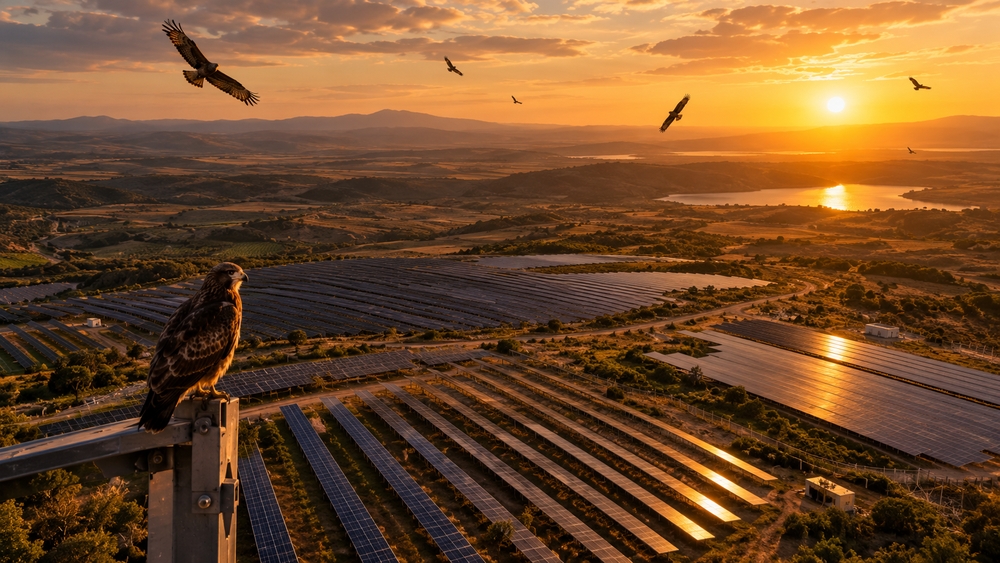
But what attracts predators to a seemingly lifeless field with panels? The authors offer a simple and logical explanation. First, the solar farm infrastructure — panels, supports, and fencing — creates numerous convenient perches from which to spot prey and rest. Second, and most importantly, it is here, protected by the panels, that small rodents thrive, especially voles, which are the primary food source for many predators. The grass beneath the panels is less exposed to agricultural cultivation, allowing the rodent colonies to feel relatively safe.
This discovery has far-reaching implications. In Poland, farmland accounts for approximately 60% of the land area, and it is here that new solar power plants have been rapidly built in recent years. While this typically raises alarm among environmentalists, the work of Polish scientists demonstrates that, with the right approach, solar farms can not only provide clean energy but also become an unexpected refuge for birds of prey in heavily human-modified landscapes. Instead of a conflict between energy and nature, we can now speak of a mutually beneficial partnership.
Thus, the study not only expands our knowledge of predator behavior but also offers a new perspective on the role of renewable energy in preserving biodiversity — an issue that is becoming increasingly relevant in the era of climate change and large-scale landscape transformation.
Source:
In order to leave a comment, you need to log in!