

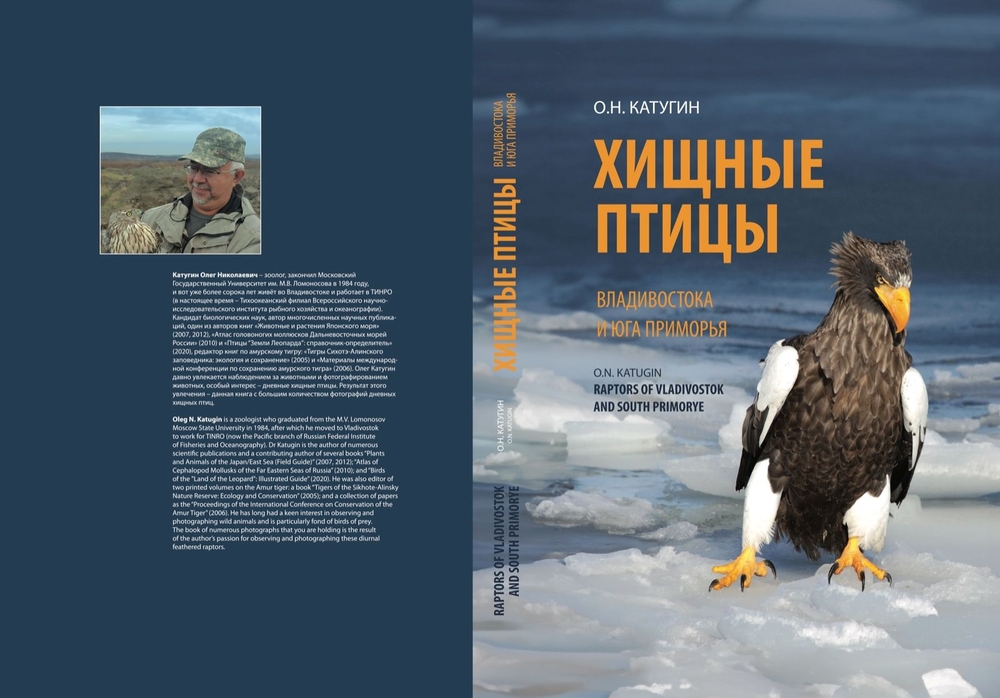
Birds of prey of Vladivostok and southern Primorye
A book about birds of prey in southern Primorsky Krai has been published
A unique bilingual atlas, "Birds of Prey of Vladivostok and Southern Primorsky Krai", has been published in Vladivostok. Its author, Oleg Nikolaevich Katugin, PhD in Biology and Deputy Head of the Department of International Scientific and Technical Cooperation and Advanced Development at the Pacific Branch of the Russian State Research Center "VNIRO" (TINRO).
The book is the result of the author's many years of observation and passion for photographing birds of prey. This nearly 400-page publication contains over 500 photographs and scientific descriptions of 27 species of diurnal birds of prey found in southern Primorsky Krai. The texts are presented in Russian and English, making the atlas accessible to both Russian and international specialists and nature enthusiasts.
The book is particularly interesting because it provides detailed information about the birds that can be found in Vladivostok and its environs. Peregrine falcons hunt in the central square, Steller's sea eagles soar over Zolotoy Rog Bay, and rare crested eagles nest in the hill forests—Vladivostok can rightfully be called a city where wildlife seamlessly blends into the urban landscape.
The southern part of Russia's Far East is renowned for its rich biodiversity: over 500 bird species are found in the Primorsky Krai, many of which can be observed at various times of the year within the city limits or its environs. However, approximately 60% of the region's diurnal raptor species are listed in the Red Data Books, emphasizing the importance of their study and conservation. O.N. Katugin's atlas is an important contribution to this endeavor and a valuable reference for anyone interested in the nature of the Far East.
To contact the author:
Email: okatugin@mail.ru
Telegram: +7-914-718-6533
Source: Far Eastern Branch of the Russian Academy of Sciences
In order to leave a comment, you need to log in!