

Medieval birds of prey fed more on human waste than hunted.
Isotopic reconstruction of the diets of British birds of prey over the past 4,000 years: from synanthropy to modern dietary niches
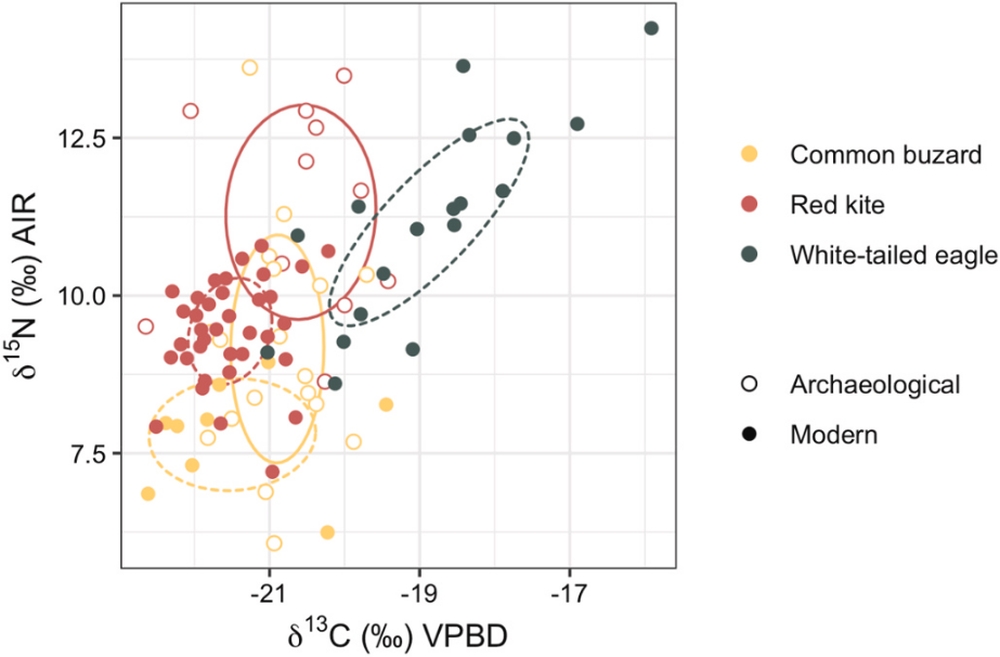
A study published in the Journal of Archaeological Science (Waterman et al., 2025) used stable carbon (δ13Cδ13C) and nitrogen (δ15Nδ15N) isotopes in bone collagen to compare the dietary niches of three diurnal raptor species – the red kite (Milvus milvus), the common buzzard (Buteo buteo), and the white-tailed eagle (Haliaeetus albicilla) – using archaeological samples from the Chalcolithic–Early Bronze Age, Iron Age, Roman period, and medieval periods (c. 2300 BC–1400 AD) from southern and central England, as well as Orkney Islands (Scotland). The sample included 30 individuals from excavated sites, including the settlements of Danbury, Winchester, and Oxford; data from modern individuals of the same species from the Scottish Highlands (1980s–2010s) were used for comparison.
Metric differences. Archaeological kites and buzzards were found to have statistically significantly higher δ15Nδ15N values than modern populations (two-way ANOVA: effect of period – F1,70=25.64, p<0.001 F1,70=25.64, p<0.001; effect of species – F1,70=15.07, p<0.001 F1,70=15.07, p<0.001). For red kites, archaeological samples demonstrate an average δ15N of 11.3‰ (SD = 1.6) versus 9.4‰ (SD = 0.8) for modern samples; for common buzzards, it is 9.2‰ (SD = 1.8) versus 7.8‰ (SD = 0.9), respectively. δ13C values are also significantly less negative in archaeological groups (F1,70 = 18.39, p < 0.01), reflecting differences in the ratio of terrestrial vs. marine/anthropogenic dietary components, as well as possible changes in isotopic background (including the Suess effect for modern samples).
Niche Overlap Dynamics. Standard ellipses (SEAc, SIBER Bayesian approach) show that the overlap in isotopic niches between archaeological and modern kites is extremely small (<1% overlap), while for buzzards, the overlap reaches 29%, indicating that the latter retain part of their original dietary strategy. Moreover, the δ15Nδ15N spread in archaeological specimens of both species is significantly wider: for kites, the range is 8.6–13.5‰ (modern 7.2–10.8‰), and for buzzards, 6.1–13.6‰ (modern 6.2–8.9‰). The medieval birds are particularly notable: five of eight kites and three of four buzzards have δ15Nδ15N values exceeding the maxima of modern populations.
Interpretation of trophic shifts. High δ15Nδ15N values of archaeological predators are consistent with the consumption of prey occupying higher trophic levels—primarily carrion and scraps from the butchering of domestic ungulates (cattle, sheep, pigs), as well as possibly omnivorous synanthropes (rats, crows) or poultry. Comparison with local isotope databases from the same sites (Danbury, Winchester, Oxford) confirms that the isotopic values of predators fall within the range expected for a trophic enrichment of Δ15N=+3.0‰Δ15N=+3.0‰ relative to herbivores and pigs. Moreover, in Roman Winchester, the kite profile is almost identical to that of pigs and chickens, directly indicating the use of meat by-products. In medieval Oxford, kite values even exceed human maximums (>12.7‰).
The Role of Rabbit Absence. An important ecological factor is the absence of wild rabbits (Oryctolagus cuniculus) in Britain until the late Middle Ages, which form the basis of the modern diet of buzzards and kites. In archaeological settings, with the shortage of this stable food resource, predators were forced to exploit a wider range of alternative prey, including anthropogenic carrion, which led to an expansion of their dietary niches.
White-tailed Eagles. For three archaeologically identified eagles (one individual from the Fishbourne Roman palace on the south coast and two from a Neolithic tomb in Orkney), δ15Nδ15N and δ13Cδ13C values are significantly higher than those of modern Scottish individuals (up to δ15N=15.6‰), indicating the predominance of high-trophic marine resources (large fish, seals) in the diet of ancient island populations, while modern eagles show a greater proportion of terrestrial carrion.
Conservation significance. The data obtained provide historical insight into contemporary conflicts between birds of prey and humans. The recolonization of urban areas (e.g., Reading) by red kites and their feeding on food scraps, perceived as "pest," is in fact a millennia-old evolutionary strategy rather than a new behavioral aberration. Understanding the long-term dynamics of dietary niches is critical for developing adequate population management measures in the face of ongoing urbanization and changes in organic waste management systems. The authors emphasize that reduced availability of carrion in modern agricultural landscapes can exert pressure on predators, facilitating their shift to alternative, sometimes conflicting, food sources, which must be considered in conservation and reintroduction programs.
Sourse: Waterman, J., Black, S., Sykes, N., Mills, W. F., Doherty, S., Britton, H., Smallman, R., Sheridan, A., Kitchener, A. C., & Fellowes, M. D. E. (2025). Tracking 4000 years of raptor diets through isotope analysis reveals urban scavenging with implications for conservation. Journal of Archaeological Science, *175*, 106147. https://doi.org/10.1016/j.jas.2024.106147
In order to leave a comment, you need to log in!